
Big Rocks and Small Streams in the Appalachian Valley & Ridge
PROJECT OVERVIEW
What: This Gateway project focuses on headwater streams in the Appalachian Valley & Ridge to investigate if they are underpowered relative to their sediment supply and to determine major climate history controls on changes in the immovable fraction of channel sediment. The main educational goal of the project is for students to collaborate on a field-based and lab-based project that requires them to apply principles of both hard-rock geology and earth surface processes to answer relevant scientific questions.
When: July 06-August 06, 2027
Where: Amherst College, Amherst, Massachussetts (home base); Valley & Ridge of Virginia and Pennsylvannia (field area); GSA Annual Meeting in Montréal, Canada (17-20 October 2027)
Who: Five students, a peer mentor, and project directors Dr. Michelle Fame (Amherst College) and Dr. Joanmarie Del Vecchio (The College of William & Mary)
Prerequisites: Because this experience is a Gateway Project for rising sophomores, there are no specific coursework prerequisites.
Expectations and Obligations:
1. Participation in all summer project-related work and the professional conference during the following academic year.
2. Submission of an abstract (individual or in groups) and co-presentation of a paper (poster) at the Geological Society of America Meeting in Montréal in October, 2026 (all expenses covered).
3. Participation in all Keck REU activities including (e.g., surveys and reflections).
4. A valid passport may be required for travel to the GSA conference in Montréal.
Cost and Stipend:
All travel, lodging, food, and research-related costs are covered by the project. Each student receives a stipend of $3,500 over the course of the summer project and conference participation. For students with financial need, some support is available for the purchase personal gear.
PROJECT DESCRIPTION
In the Appalachian Valley and Ridge Province, layered and folded sedimentary rocks of contrasting weatherability exert a primary control on the topography. Long linear ridges comprising resistant quartz-rich sandstones hold up the drainage divides while more easily weatherable carbonates and shales dominate the low valleys. However, ridge forming sandstones can exert a significant influence on lower elevation portions of the landscape as they weather and shed large, resistant blocks onto hillslopes and into headwater channels. These quartz-rich boulders armor the underlying carbonates and shales and can produce hillslope erosion rates much slower than expected for a given slope angle. Additionally, large blocks of rock that reach headwater channels and are too large to be moved by typical “channel forming” stream flows, increase bed drag and shield smaller grains from transport, thus limiting the efficacy of fluvial transport.
Preliminary qualitative field observations indicate that hillslope and channel boulder size increases along a north–south gradient from Pennsylvania to Virginia while, at the same time, frequency of the largest grain size decreases (Figure 1). In other words, lower latitude streams have a few very large boulders in their channels (>~2 m) and higher latitude streams have many slightly smaller blocks (<~0.5 m). In this study we propose to investigate: (1) what controls boulder size distribution and frequency in Appalachian Valley and Ridge headwater channels and (2) how these boulders affect headwater channel’s ability to mobilize incoming sediment supply. Field observations and cosmogenic exposure dating suggests periglacial frost weathering as the dominant mechanism for detachment and deposition of these sandstone boulders. Therefore, a paleoclimate driven explanation for the north-south boulder trends could reflect differences in periglacial temperature and frost-driven weathering intensity with increasing distance from the Laurentide Ice Sheet margin during past glacial periods (Figure 2). However, this north-south trend could also reflect systematic along-strike variations in ridgeline bedrock properties or structural style which influence initial fracture spacing (Figure 3).
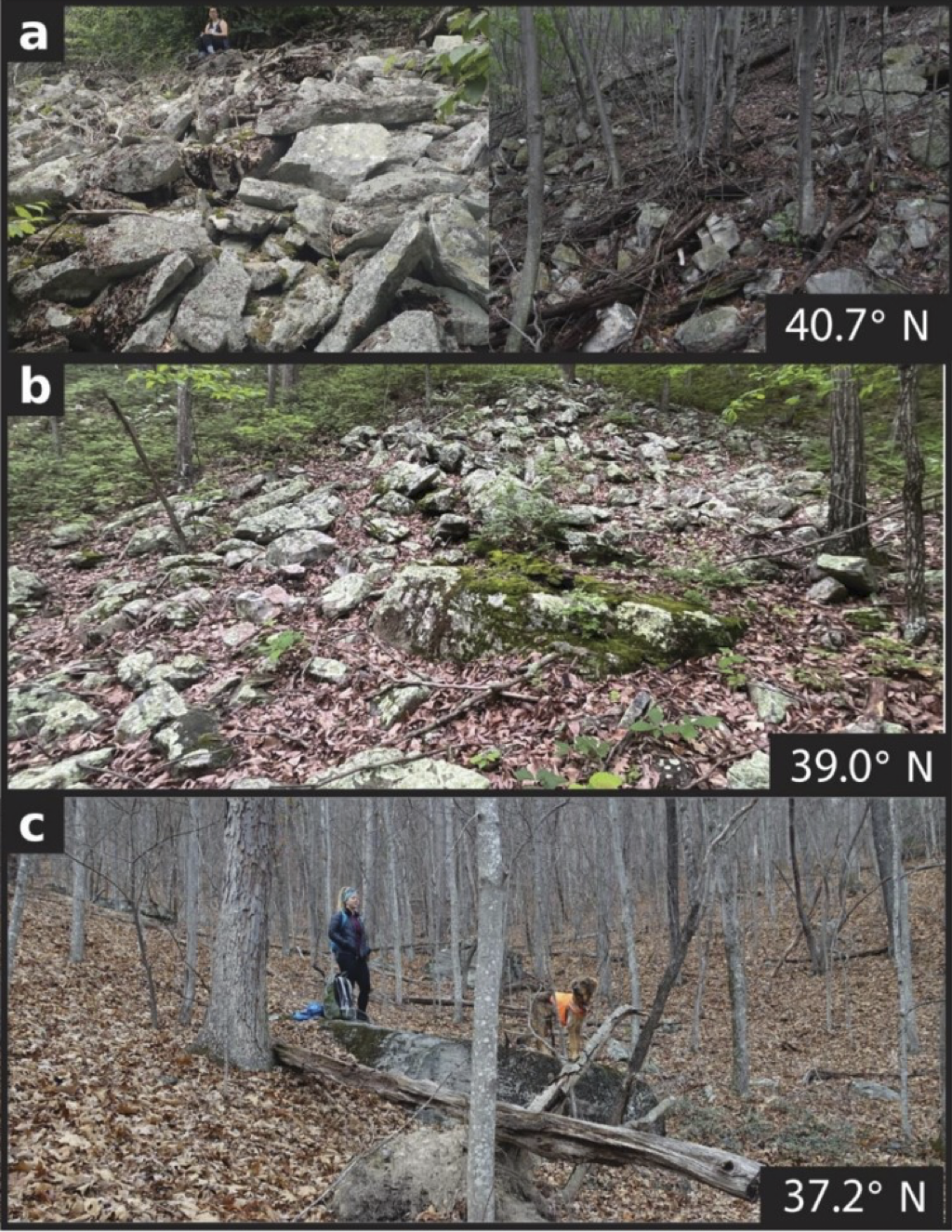
Figure 1. Appalachian Valley and Ridge hillslope boulders at latitudes of (A) 40.7ºN, (B) 39.0ºN, and (C) 37.2ºN show, qualitatively, an increase in maximum grain size and decreasing frequency of the largest grainsize from north to south (figure courtesy of DelVecchio et al., 2026).
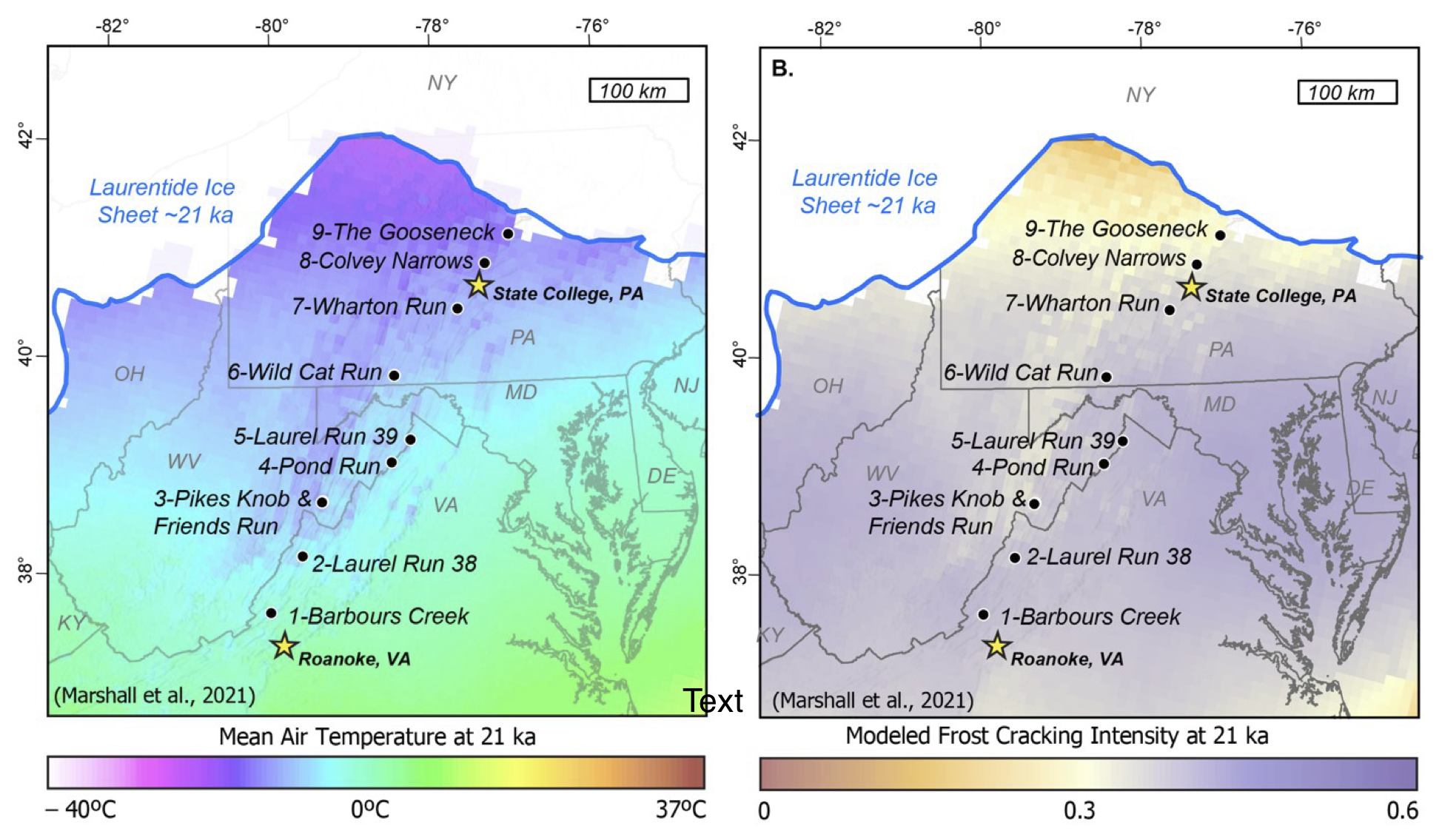
Figure 2: The proposed north-south array of field sites for this project in central and southern Appalachia along with (A) mean air temperature and (B) modeled frost cracking intensity south of the Laurentide Ice Sheet limits during the Last Glacial Maximum, at 21 ka (Marshall et al., 2021). Also shown is the fieldwork starting location (Roanoke, VA) and end location (State College, PA).
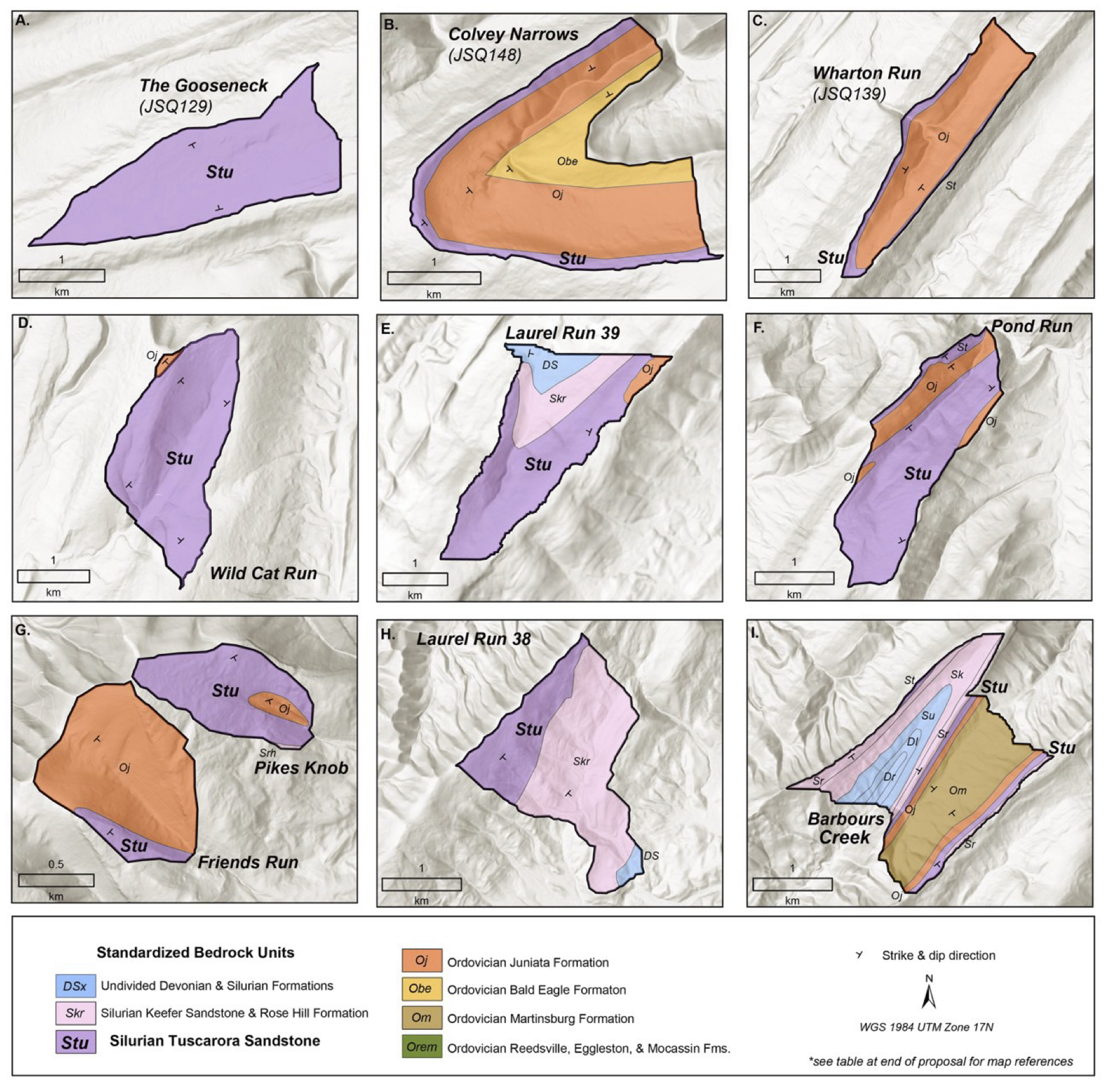
Figure 3: This figure shows the compiled bedrock geology within the drainage basin areas for the nine proposed headwater stream field sites (see locations in Figure 2). The Silurian Tuscarora Sandstone, or Stu (in purple), outcrops along the ridges of all catchments although the outcrop prevalence and structure are quite different in each site. See the table at the end of the reference list for bedrock geology source map references and map scales.
Potential Student Projects
Two teams of Keck Gateway Students will lead the first two projects while the third will build off those and form the basis of the Near-Peer Mentor’s thesis or independent research project during the following academic year. Although each team will have one project as their primary focus, students will be encouraged to participate in the data collection process for all projects so they can learn a wide array of field and lab methods. All methods will be pplied to all nine Tuscarora headwater catchment study sites in Virginia, West Virginia, and Pennsylvania (Figures 2 & 3).
Project 1 – Along-strike characterization of the Tuscarora Sandstone: Students will measure bedding thickness and fracture spacing on ridgeline Tuscarora outcrops using outcrop scale fracture scanline surveys and collect rock samples for lab analyses. In the lab at Amherst College, they will use thin-section petrography and SEM analyses to test whether Tuscarora composition, texture, and cementation vary along strike. This project addresses our first research question by determining how bedrock properties might influence the north–south trend in boulder size and frequency.
Project 2 – Channel grain size distribution and critical shear stress: Students will use the Wolman Pebble Count method to characterize grain size distributions within several equally spaced cross sections in each headwater channel. At each stream cross section, they will also measure channel dimensions and flow parameters to calculate the bankfull shear stress available to entrain sediment during channel-forming flows (τ = ρwgDsinθ, where τ = shear stress, ρw=density of water, g = gravitational acceleration, D = flow depth, and θ = channel slope). By comparing bankfull shear stress to the critical shear stress necessary to entrain sediments with the measured grain size distribution, they will identify the largest mobile grain size and the fraction of channel sediment that can be moved (τc = τc *g(ρs – ρw)d, where τc = critical shear stress, τc *= shield parameter, ρs= density of sediment, and = grain size). This project addresses our second research question by quantifying what fraction of the grain size distribution streams can transport and how this might vary between sites.
Project 3 – Grain size, rock properties, and periglacial climate: The Near-Peer Mentor’s senior thesis or independent study during the 2027 – 2028 academic year will be focused on a comparison of grain size distribution and maximum transportable grain size in headwater channels to bedrock characteristics and LGM periglacial temperature. This project will integrate and build upon the results of Keck Gateway Projects 1 and 2. It will also add in an additional parameter to quantify rock strength by doing point load testing of Tuscarora outcrops and channel samples in the Geoscience Department at Virginia Tech in collaboration with Dr. Kristin Chilton to directly quantify their strength differences. This project should address whether periglacial weathering or bedrock properties control boulder size and whether inherited coarse grain sizes limit the efficacy of headwater stream transport capacity.
Project Logistics
Project Participants: This Keck Gateway Project will include five rising sophomores (with no prerequisite requirements) and one rising junior or senior Amherst College Geology major to act as the project’s Near-Peer Mentor.
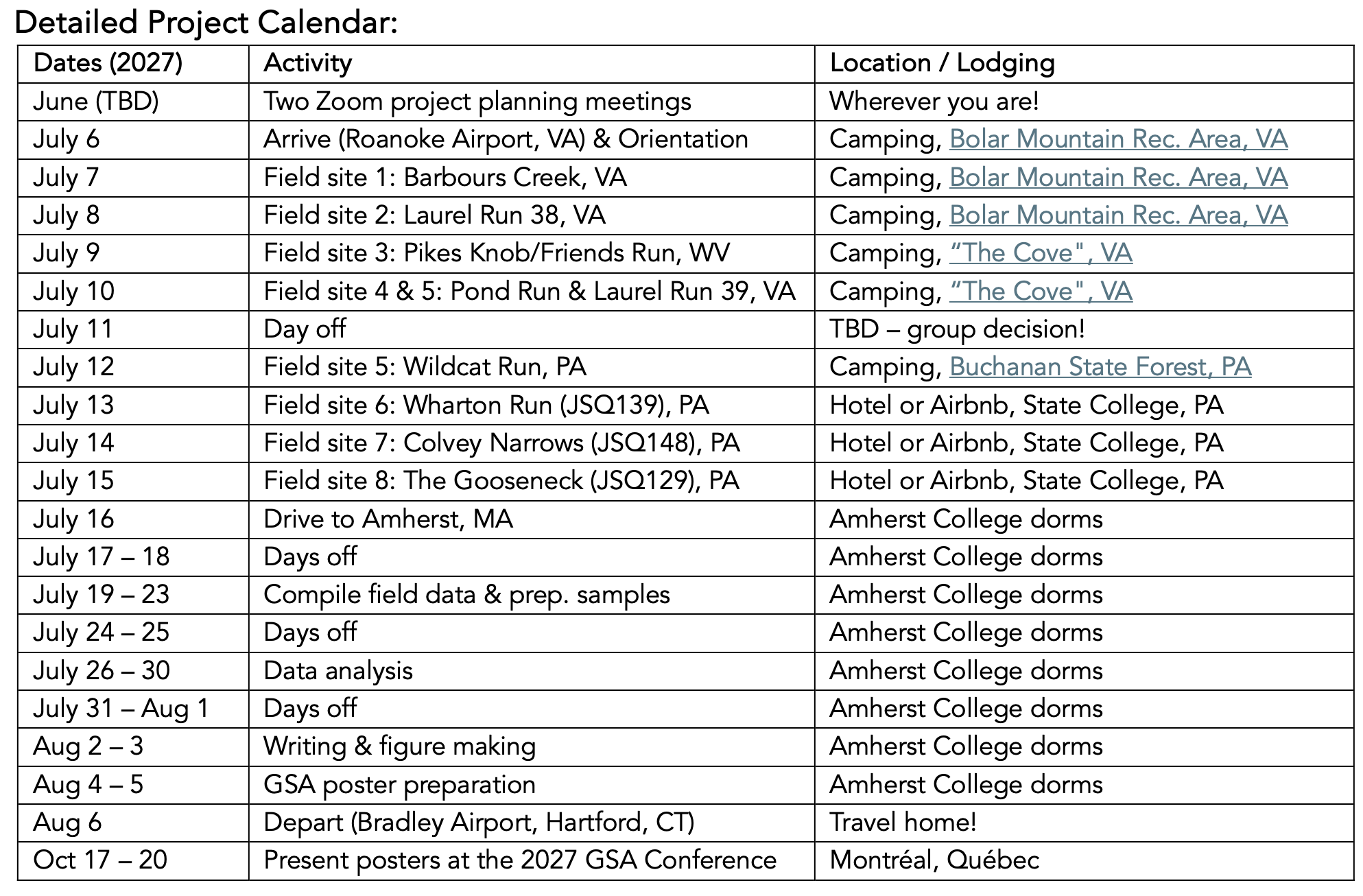
Travel, Fieldwork, Room, and Board: For this project, students will fly into the Roanoke Regional Airport, Virginia where we will meet them in the Amherst College Geology Van. We will then spend the first ~10 days doing fieldwork while camping or staying in hotels as we slowly make work our way north through field sites in Virginia, West Virginia, and Pennsylvania. We will also have readings, reading discussions, and short lectures at camp during the field work block to introduce the students to important concepts related to the project. Students will be expected to assist with meal preparation and clean up while camping. When our field work is complete, we will drive to Amherst College, Massachusetts where students will live in the dorms and eat in the dining hall for the last three weeks of the project. While at Amherst College they will do the lab work, interpretation, and poster creation component of the project. Students will depart for home at the end of the project from Bradley International Airport in Hartford, Connecticut.
Safety and Inclusivity
Safety and Inclusivity: This project involves a substantial amount of field work and camping in rural Appalachia. Our goal is for any interested student to feel comfortable participating regardless of their previous outdoor experiences or personal identity. We will discuss the following major safety and inclusivity concerns and our plan to mitigate them during the pre- project Zoom meetings:
- Fall hazards from walking on uneven ground and through slippery creek beds: Students will be required to wear comfortable and sturdy field boots, be trained in safe field travel and sampling techniques, and will always work in groups of two or more. The project directors also plan to refresh their Wilderness First Aid Certification before the field season.
- Weather hazards related to summer heat, humidity, sunburns, and thunderstorms: As a group, we will monitor daily weather forecasts and schedule strenuous field work for cooler hours, provide drinking water and sunscreen, and plan to take cover during thunderstorms
- Plant and animal hazards such as tick-borne diseases, stinging insects, and poison ivy: We will provide training in hazardous plant and animal identification and encourage daily tick checks.
- Limited cell service and long distances to medical facilities: All teams will a carry a stocked first aid kit and radios to communicate between groups. Project leaders will carry a Garmin in Reach whenever we are in areas outside of cellular service in case of emergencies. We will also have a second car and faculty member in the field that can take a student to medical care separate from the rest of the group, if needed.
- Working in rural Appalachian communities that may feel unfamiliar or unwelcoming to some students: While in the field, students should always travel with a buddy and are never required to interact with people outside of our group. We will have group and one-on-one discussions prior to going to the field to discuss and attempt to mitigate individual student concerns.
Expectations for Students
The most important expectation for students is to be curious, engaged, flexible, responsible, and to support and communicate openly with all members of the research team. Lodging during the project will be a combination of car camping, college dorms, and the occasional hotel. Students should expect shared rooms in dorms and hotels and varying levels of amenities when camping (such as flush toilets, running water, and showers). Although we will do our utmost to accommodate dietary restrictions, flexibility around food preference will be essential in rural areas. Students should be prepared to spend long days outdoors in hot, humid conditions. Field work will include hiking off trail on steep hillslopes, bushwhacking through rhododendron, and wading in shallow streams. Students will need to have sturdy boots, rain gear, water bottles, and a daypack for this project. If student’s financial situation precludes them from obtaining these essential items, they should ask for additional support. We have wading boots, field equipment, and camping supplies that can be loaned to students, though hey are also welcome to bring their own if they prefer. No previous research, field, or camping experience is required, as we will teach students everything they need to know!
Description of Facilities
While in the field, we will use the Amherst College Geology Department’s 15-passenger van, along with camping and field gear from the Amherst College Geology Department and the Amherst College Outing Club. While at Amherst College, students will be housed in the college dorms and will eat with all other on-campus summer students in the Amherst College Dining Hall. For sample preparation, we have a rock saw, a thin-section lab, scanning electron microscopes, and petrographic microscopes that students can use to prepare and analyze samples. Amherst College also has support staff in the Geology Department to help students use the rock-preparation equipment (Gideon Morse) and the SEM (Hanna Bock).
Professional Development Component
Students will present their results as a group poster at the Geological Society of America (GSA) 2027 meeting in Montréal, Québec (17–20 October 2027). Because the meeting is in Canada, we will help students apply for passports so international travel is not a barrier. Before the meeting, we will a few Zoom sessions so they can practice presenting their posters and to discuss conference attendance strategies. At the conference students will present their posters, attend relevant talks, and meet up for a group dinner with their Keck group.